China's deposit insurance pays one person up to 500,000 yuan at each bank
Deposit insurance pays out bank by bank, within a deadline and with exclusions; the balance and coins in an exchange account fall outside it.
- Which deposits are insured and how the 500,000 yuan is counted
- When a bank really fails, where does payment start?
- Why money and coins in an exchange account are not covered by deposit insurance
- Sort your money into bank deposits, exchange balances and coins in your own wallet
- Foreign bank branches and housing fund deposits follow other rules, and banks pay the premiums
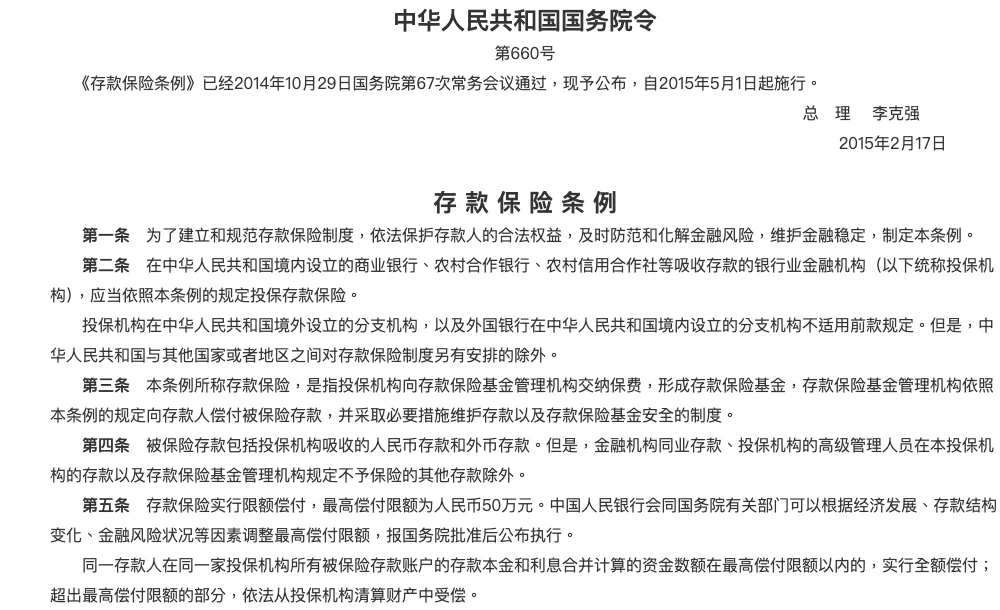
Money in a bank in mainland China is backed by the Deposit Insurance Regulations (published in Chinese). If one person's deposits at one bank come to 500,000 yuan or less, principal and interest combined, they are paid in full if the bank fails; anything above 500,000 yuan is recovered, as the law provides, from that bank's liquidation assets. That is Article 5, and the regulations have been in force since 1 May 2015.
Money and coins placed with an exchange have no such layer. Article 2 limits insured institutions to deposit-taking banking institutions set up within the People's Republic of China, such as commercial banks, rural cooperative banks and rural credit cooperatives. Exchanges are not on that list, so the balance and coins in an exchange account are not insured deposits.
Which deposits are insured and how the 500,000 yuan is counted
| Article | What it lays down | What it means for your own deposits |
|---|---|---|
| Article 2 | Commercial banks, rural cooperative banks, rural credit cooperatives and other deposit-taking banking institutions set up in China are insured institutions and must take out deposit insurance | Start with what kind of institution holds the money |
| Article 4 | Insured deposits include RMB and foreign-currency deposits taken by insured institutions; excluded are interbank deposits between financial institutions, deposits that an insured institution's senior managers hold at that institution, and other deposits the deposit insurance fund manager rules out | RMB and foreign-currency deposits both count, unless they fall into one of these three exclusions |
| Article 5 | Payment is capped, with a maximum of 500,000 yuan; principal and interest in all insured accounts of the same depositor at the same insured institution are added together, paid in full up to the cap, and anything above it is recovered from the institution's liquidation assets as the law provides | Current accounts, time deposits and several cards at one bank are counted together |
| Article 19 | The deposit insurance fund manager must pay the deposits in full within 7 working days of a specified event | The part within the cap comes with a payment deadline |
If the same 530,000 yuan were split across two banks instead, 300,000 at one and 230,000 at the other, Article 5 combines deposits only within “the same insured institution”, so each bank is counted on its own and both amounts fall within 500,000 yuan.
The 500,000 yuan figure is set in paragraph 1 of Article 5, and the same paragraph leaves room to change it: the People's Bank of China, together with the relevant State Council departments, may adjust the maximum payout in light of economic development, changes in the structure of deposits, financial risk and other factors, and the new figure takes effect once the State Council approves it and it is published.
When a bank really fails, where does payment start?
The payment deadline in the table does not start on the day bad news about a bank comes out. Article 19 lists four situations, and only once one of them occurs can depositors require the deposit insurance fund manager to use the fund to pay insured deposits up to the cap:
- the fund manager acts as the receiver taking over the bank;
- the fund manager carries out the liquidation of a bank that has been closed down;
- a people's court accepts a bankruptcy application against the bank;
- other situations approved by the State Council.
The 7 working days are counted from the date one of these occurs.
The money may not come straight from the fund, either. Article 18 gives the fund three ways to act: pay directly up to the cap; appoint another qualified insured institution to pay on its behalf up to the cap; or give another qualified insured institution guarantees, loss sharing or funding so that it buys or takes on all or part of the failed bank's business, assets and liabilities. The regulations require the choice to follow the principle of the lowest cost to the fund. For a depositor, that may mean collecting the money at another bank, or the deposit moving along with the business to the bank that takes it over.
Why money and coins in an exchange account are not covered by deposit insurance
Once money moves from your bank card to an exchange, it stops being your deposit at the bank, and that stays true after it has been turned into coins. Stablecoins such as USDT track the US dollar, but they are not foreign-currency deposits taken in by an insured institution, so Article 4 does not reach them. Coins withdrawn to a wallet of your own are outside the regulations as well, because no bank has taken them in as a deposit. The different kinds of wallet are explained in What Is a Wallet? Exchange, Hot, and Cold Wallets — Which You Need.
The United States makes a useful comparison. The Federal Deposit Insurance Corporation (FDIC) has a fact sheet written for the public stating that FDIC insurance does not protect against the default, insolvency or bankruptcy of any non-bank entity, including crypto custodians, exchanges, brokers, wallet providers and neobanks. That is the FDIC speaking about US deposit insurance; it applies in the United States and is a separate system from China's regulations.
If a platform runs into trouble, what happens to the assets in your account does not go through the deposit insurance payment process, so the 500,000 yuan cap and the 7 working days don't apply.
Sort your money into bank deposits, exchange balances and coins in your own wallet
Make a list of your money by where it is held, and check each place against it:
- Current and time deposits in a bank account. These are the deposits Article 4 talks about. For other products sold in the same banking app, check whether the contract calls it a deposit before you buy; the regulations cover deposits only.
- Balances and coins in an exchange account. Find the user agreement in the platform's help center, pick out every clause on asset custody and on what happens if the platform goes bankrupt or stops operating, read them one at a time, and write down anything unclear to ask the platform's customer support.
- Coins in your own wallet. There is no deposit insurance and no platform in between. Safekeeping is entirely in your hands, so settle how the wallet will be backed up before you move coins into it.
Foreign bank branches and housing fund deposits follow other rules, and banks pay the premiums
Are deposits at a foreign bank's branch in China covered by deposit insurance?
Paragraph 2 of Article 2 states that the insurance requirement does not apply to branches that foreign banks set up within the People's Republic of China, except where China has a separate deposit insurance arrangement with the country or region concerned. The same paragraph also leaves out branches that insured institutions set up outside China. Before opening an account, you can ask whether it is a bank established in China or a foreign bank's branch operating there.
Are housing provident fund and social security fund deposits also paid up to 500,000 yuan?
These two kinds of deposit are handled separately. Paragraph 4 of Article 5 states that the payment rules for social insurance fund and housing provident fund deposits are drawn up separately by the People's Bank of China with the relevant State Council departments and submitted to the State Council for approval.
Do depositors have to pay the deposit insurance premium themselves?
No, the insured institutions pay it. Article 3 defines deposit insurance as a system in which insured institutions pay premiums to the deposit insurance fund manager to build up a deposit insurance fund, and the manager pays insured deposits under the regulations; Article 10 requires insured institutions to pay premiums every 6 months. Article 6 lists where the fund comes from: premiums, assets distributed in the liquidation of insured institutions, returns from investing the fund and other lawful income.
The wording of the regulations follows the Deposit Insurance Regulations (State Council Decree No. 660) as published in Chinese on the Chinese government website, gov.cn; the FDIC position is from its Fact Sheet: What the Public Needs to Know About FDIC Deposit Insurance and Crypto Companies, which applies in the United States. This article covers only how far deposit insurance reaches and is not financial or investment advice.